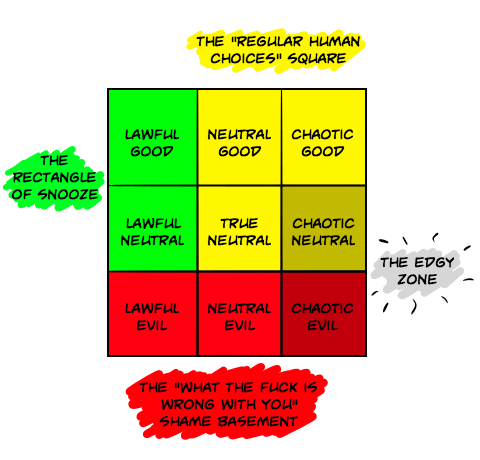
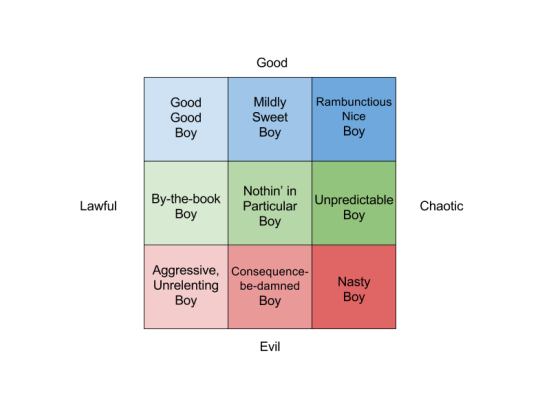
can someone explain the alignment chart for me but in like, the simplest wording possible lmao
lawful good: i want to do the right thing, and following society’s rules is the best way to do that
neutral good: i want to do what’s right, and i’m willing to bend or break the rules as long as no one gets hurt
chaotic good: i’m willing to do whatever it takes as long as it’s to do the right thing
lawful neutral: following the rules of society is the most important thing, and that matters more to me than doing what’s right
true neutral: i just want myself and the people i care about to be happy
chaotic neutral: i want my freedom, and i don’t care what i have to do to keep it
lawful evil: to impede the protagonists (in whatever evil way) is my primary goal, but i follow my own code of morals even when it’s inconvenient
neutral evil: to impede the protagonists (in whatever evil way) is the my primary goal, and while i’ll do what it takes to achieve it, i also won’t go out of my way to do unnecessary damage
chaotic evil: i relish in destruction and want to do as much damage as possible while i try to achieve my primary goal
Citizen is simpler and more beautiful~ but just in case anyone needs this.
DUDE BUT THIS IS WHAT I’VE BEEN TRYING TO TELL PEOPLE
in medieval times you ONLY addressed a king/queen with “Your Majesty”, NEVER “Your Highness”. To address a king/queen with “Your Highness” was considered an insult.
A deadly monster with a terrifying appearance bonds with a small child and protects the small child with its life.
An injured hero comes upon a monster, or a hero comes upon an injured monster, and they have a Moment where they understand each other.
Giant vicious-looking monsters that answer to names you would give a pet dog.
A character rescues or spares the life of a wounded or infant monster; later, the fully-grown/recovered creature returns the favor.
A monster is only behaving aggressively to defend its young; the heroes realize this and make piece with the creature before leaving it be.
Similarly, a monster is only behaving aggressively because it is displaced and frightened; the heroes realize this, and help it to return home.
The horrifying eldritch creature that has been stalking the heroes turns out to be wholly benevolent, and its previously menacing behavior is revealed to be its attempts to protect them from something far deadlier.
BENEVOLENT MONSTERS!!!! BENIGN MONSTERS!!!! MONSTERS YOU DON’T HAVE TO FIGHT!!!
This masterlist is a masterlist of words that you may use alongside the word very, very being one of the most common words that are used when writing. I hope this helps you as much as it helps me in our writing seem more sophisticated and unique.
A:
Very accurate – exact Very afraid – fearful Very angry – furious Very annoying – exasperating
B:
Very bad – atrocious Very beautiful – exquisite Very big – immense Very boring – dull Very bright – luminous Very busy – swamped
C:
Very calm – serene Very careful – cautious Very cheap – stingy Very clean – spotless Very clear – obvious Very clever – intelligent Very cold – freezing Very colourful – vibrant Very competitive – cutthroat Very complete – comprehensive Very confused – perplexed Very conventional – conservative Very creative – innovative Very crowded – bustling Very cute – adorable
D:
Very dangerous – perilous Very dear – cherished Very deep – profound Very depressed – despondent Very detailed – meticulous Very different – disparate Very difficult – arduous Very dirty – filthy Very dry – arid Very dull – tedious
E:
Very eager – keen Very easy – effortless Very empty – desolate Very excited – thrilled Very exciting – exhilarating Very expensive – costly
F:
Very fancy – lavish Very fast – swift Very fat – obese Very friendly – amiable Very frightened – alarmed Very frightening – terrifying Very funny – hilarious
G:
Very glad – overjoyed Very good – excellent Very great – terrific
H:
Very happy – ecstatic Very hard – difficult Very hard-to-find – rare Very heavy – leaden Very high – soaring Very hot – sweltering Very huge – colossal Very hungry – ravenous Very hurt – battered
I:
Very important – crucial Very intelligent – brilliant Very interesting – captivating
J:
K:
L:
Very large – huge Very lazy – indolent Very little – tiny Very lively – vivacious Very long – extensive Very long-term – enduring Very loose – slack Very loud – thunderous Very loved – adored
M:
Very mean – cruel Very messy – slovenly
N:
Very neat – immaculate Very necessary – essential Very nervous – apprehensive Very nice – kind Very noisy – deafening
O:
Very often – frequently Very old – ancient Very old-fashioned – archaic Very open – transparent
P:
Very painful – excruciating Very pale – ashen Very perfect – flawless Very poor – destitute Very powerful – compelling Very pretty – beautiful
Q:
Very quick – rapid Very quiet – hushed
R:
Very rainy – pouring Very rich – wealthy
S:
Very sad – sorrowful Very scared – petrified Very scary – chilling Very serious – grave Very sharp – keen Very shiny – gleaming Very short – brief Very shy – timid Very simple – basic Very skinny – skeletal Very slow – sluggish Very small – petite Very smart – intelligent Very smelly – pungent Very smooth – sleek Very soft – downy Very sorry – apologetic Very special – exceptional Very strong – forceful Very stupid – idiotic Very sure – certain Very sweet – thoughtful
T:
Very talented – gifted Very tall – towering Very tasty – delicious Very thirsty – parched Very tight – constricting Very tiny –minuscule Very tired – exhausted
U:
Very ugly – hideous Very unhappy – miserable Very upset – distraught
V:
W:
Very warm – hot Very weak – frail Very well-to-do – wealthy Very wet – soaked Very wide – expansive Very willing – eager Very windy – blustery Very wise – sage Very worried – distressed
X:
Y:
Z:
A/N: If you know of anymore words I can add please message me.
1. Humans say ‘ow’, even if they haven’t actually been hurt. It’s just a thing they say when they think they might have been hurt, but aren’t sure yet.
2. Humans collect shiny things and decorate their bodies and nests with them. The shinier the better, although each individual has a unique taste for style and colouring
3. Humans are not an aquatic or even amphibious species, but they flock to bodies of water simply to play in it. They can’t even hold their breath all that long; they just love to splash!
4. When night falls and the sky goes dark, humans become drowsy and begin to cocoon themselves in soft, fluffy bedding.
5. Some humans spend time in each other’s nests! Just for fun! It’s not their nest; they’re just visiting each other.
6. Some humans use pigments and dyes to make their bodies flashy and colourful! They even attach shiny dangly bits to their cartalidgous membranes!
7. Humans are very clever, and sometimes adopt creatures from other species into their family units. They don’t seem to notice the obvious differences, and often raise them alongside their own young!
8. If a human sees another creature in distress, they can commonly be observed trying to help! Even at their own risk, most humans are deeply compassionate creatures!
9. If a human hears a particularity catchy sound or tune, it will often mimic it, even to the point of annoying themselves!
10. Sneezes are entirely involuntary, and completely adorable. Especially when the human in question becomes frustrated
11. Humans love treats!!! Some more than others. Many humans will save these treats specifically for a later date when they are in need of comfort or reassurance. IE, pickles, pop tarts, Popsicles, etc
12. They’re learning to travel in space!!! They can’t get very far, but they’re trying!!! So far, they’ve made it to the end of their yard, and have found rocks
“What, my homeland? Oh, don’t get me started! Where should I begin?” Follow the directions below to generate the outline of a marvellous, far-away land, and interpret as you see fit.
Geography and Climate (Roll 1d12): 1. A layer of earth and moss scraped across bedrock 2. Dry soil heaped in ever shifting dunes 3. Rocky shores and chilly wind 4. Towering mountains 5. Great climbing hills and sloping valleys 6. Plains stretching beyond the horizon 7. Lowlands pocked with lakes and rivers 8. Fire spewing fissures 9. Deep canyons and deeper caves 10. Dripping forests 11. Scrubby tundra 12. Rugged, tangled evergreens
History (Roll 2d6): 2 -4. Passed from warlord to warlord 5 – 6. Total isolation 7. A slow cultural takeover 8 – 10. Unwavering religious dogmatism 11-12. An unending tug-of-war between factions
Noteworthy Animal (Roll 2d6; if either die shows 1 the creatures are especially large; a 6 means they are prolific; doubles means they are magical in some way): 2 -4. Slinking carnivores 5 – 6. Soaring creatures 7. Stampeding herds 8 – 10. Chattering, dexterous beasts 11-12. Glittering insects
Current Events (Roll 2d6; doubles means there is active conflict): 2. A very valuable natural resource has been found there recently 3-4. A new religion has taken root 5-6. Natural disasters have been common in recent years 7. A benevolent leader has united the people 8-9. A contagious disease is ravaging the population 10-11. Industry has increased recently 12. A religious crusade is beginning
Local Cultures (Roll 1d12 1d4 times): 1. A large people 2. A posh people 3. A nature loving people 4. A diminutive people 5. A warlike people 6. An industrious people 7. A water-dwelling people 8. A reclusive people 9. A festive people 10. A socialist people 11. An oppressed people 12. An ancient people
Sights Worth Seeing (roll 1d12) 1. Vampire falls 2. The Sinkhole 3. The Dead Kahn’s Temple 4. The Stepping Stones 5. The Giant’s Teapot 6. The Green Vortex 7. The Harvest Festival 8. March of the Dead 9. Sunrise Pass 10. Mushroom Hole 11. The Church Below the Earth 12. The Crimson Rain Ceremony
2. There is no problem with a story so great that it cannot be fixed in revision. Keep going.
3. If your story is as uncreative as you think it is, you wouldn’t want to write it so badly. You want to write it because there’s a unique spin on it you have never seen, and want to express. Many people may write similar stories, but it’s the details that make it personal. You may not know it now, but there is someone who is looking for exactly what you’re writing. If you don’t finish it, they’ll never see it.
4. You can write something amazing and still be met with silence. There are myriad reasons for this that have nothing to do with the quality of what you produce.
4.1 It’s okay to repeat post your work if no one has seen it.
4.2 It’s okay to post your work in multiple places.
5. You don’t have to agree with every criticism (but take it gracefully anyway).
6. Most writers are scared of the same things you are.
7. Don’t judge your works in progress against the archives of finished, polished stories other writers have put together. Archives are Internet portfolios and generally don’t show all the multitude of failures, incomplete, and draft-form works those writers are also struggling with. They aren’t perfect and you don’t have to be, either. Keep working and you will have a portfolio of your own.
8. Don’t be afraid to share your ideas with other writers. It’s not annoying as long as you’re not self-important about it. Be humble and gracious, and others will reciprocate.
8.1 You can’t write as well in a vacuum; the more people know that you are working on something, and what, the more support you will get for that work. Starting a dialogue before you post something will make it more likely people will read it when you do post it.
9. It’s okay to take breaks. If the ideas just aren’t coming, go do something else for a while.
10. Be kind to yourself. Don’t call yourself names. You are not stupid, or uncreative, or boring. You wouldn’t call other people those things, so don’t do it to yourself.
I don’t know if these are helpful to other people, but they are helpful to me, so just in case, here they are!
my FAVORITE tropes compiled thanks to some suggestions from others
a character gets a sick burn and doesn’t realize it immediately, at some point later there’s just “HEY WAIT A MINUTE”
the double take. this one’s an oldie but a goodie
the injured character makes the killing shot that saves everyone else in a dangerous situation
a character who isn’t speaking is doing something weird in the background, it’s subtle and never acknowledged it’s just there for those who notice it (pulling another character out of something they got stuck in, making a huge sandwich, etc)
the beleaguered assistant inches away from smacking their boss
“quick act natural”
in that vein, the leader character was just in a shouting match with someone and when they come back the rest of the team scrambles to look like they weren’t listening at the door
never forget: “he’s standing right behind me isn’t he”
ok but like when did self-sacrifice become synonymous with death? writers seem to have forgotten that people can make personal sacrifices for the greater good without giving their lives. plots about self-sacrifice and selflessness don’t always have to end in death. suffering doesn’t have to be mourning. you can create drama and emotional depth on your show without killing everyone. learn to explore the meaning of living rather than dying
Death. Is. NOT. The. Only. Way. To. Advance. The. Narrative.
Fun things to sacrifice for your loved ones in your free time that don’t include death and actually set up for a whole new season of high level drama:
– humanity (mostly applicable to sci-fi/supernatural genre) – memories (mostly applicable to sci-fi/supernatural genre) – love for that special someone (mostly applicable to sci-fi/supernatural genre) – emotions (mostly applicable to sci-fi/supernatural genre) – rank/position/ – yourself/your brain/your skills (give yourself over to bad guys and become their brainwashed agent so your loved ones live) – years of bloody ruthless traditions to make way for peace (hi lexa and fuck jroth tbh) – freedom (includes that of speech/mind/will) – your grandpa’s fortune – hell even material possessions have that girl sacrifice her goddamn house so they can pay off her gf’s student loans or whatever juST STOP KILLING CHARACTERS TO FURTHER YOUR PLOT
Sticking a landing will royally fuck up your joints and possibly shatter your ankles, depending on how high you’re jumping/falling from. There’s a very good reason free-runners dive and roll.
Hand-to-hand fights usually only last a matter of seconds, sometimes a few minutes. It’s exhausting work and unless you have a lot of training and history with hand-to-hand combat, you’re going to tire out really fast.
Arrows are very effective and you can’t just yank them out without doing a lot of damage. Most of the time the head of the arrow will break off inside the body if you try pulling it out, and arrows are built to pierce deep. An arrow wound demands medical attention.
Throwing your opponent across the room is really not all that smart. You’re giving them the chance to get up and run away. Unless you’re trying to put distance between you so you can shoot them or something, don’t throw them.
Everyone has something called a “flinch response” when they fight. This is pretty much the brain’s way of telling you “get the fuck out of here or we’re gonna die.” Experienced fighters have trained to suppress this. Think about how long your character has been fighting. A character in a fist fight for the first time is going to take a few hits before their survival instinct kicks in and they start hitting back. A character in a fist fight for the eighth time that week is going to respond a little differently.
ADRENALINE WORKS AGAINST YOU WHEN YOU FIGHT. THIS IS IMPORTANT. A lot of times people think that adrenaline will kick in and give you some badass fighting skills, but it’s actually the opposite. Adrenaline is what tires you out in a battle and it also affects the fighter’s efficacy – meaning it makes them shaky and inaccurate, and overall they lose about 60% of their fighting skill because their brain is focusing on not dying. Adrenaline keeps you alive, it doesn’t give you the skill to pull off a perfect roundhouse kick to the opponent’s face.
Swords WILL bend or break if you hit something hard enough. They also dull easily and take a lot of maintenance. In reality, someone who fights with a sword would have to have to repair or replace it constantly.
Fights get messy. There’s blood and sweat everywhere, and that will make it hard to hold your weapon or get a good grip on someone.
A serious battle also smells horrible. There’s lots of sweat, but also the smell of urine and feces. After someone dies, their bowels and bladder empty. There might also be some questionable things on the ground which can be very psychologically traumatizing. Remember to think about all of the character’s senses when they’re in a fight. Everything WILL affect them in some way.
If your sword is sharpened down to a fine edge, the rest of the blade can’t go through the cut you make. You’ll just end up putting a tiny, shallow scratch in the surface of whatever you strike, and you could probably break your sword.
ARCHERS ARE STRONG TOO. Have you ever drawn a bow? It takes a lot of strength, especially when you’re shooting a bow with a higher draw weight. Draw weight basically means “the amount of force you have to use to pull this sucker back enough to fire it.” To give you an idea of how that works, here’s a helpful link to tell you about finding bow sizes and draw weights for your characters. (CLICK ME)
If an archer has to use a bow they’re not used to, it will probably throw them off a little until they’ve done a few practice shots with it and figured out its draw weight and stability.
People bleed. If they get punched in the face, they’ll probably get a bloody nose. If they get stabbed or cut somehow, they’ll bleed accordingly. And if they’ve been fighting for a while, they’ve got a LOT of blood rushing around to provide them with oxygen. They’re going to bleed a lot.
Here’s a link to a chart to show you how much blood a person can lose without dying. (CLICK ME)
If you want a more in-depth medical chart, try this one. (CLICK ME)
Hopefully this helps someone out there. If you reblog, feel free to add more tips for writers or correct anything I’ve gotten wrong here.
How to apply Writing techniques for action scenes:
– Short sentences. Choppy. One action, then another. When there’s a lull in the fight, take a moment, using longer phrases to analyze the situation–then dive back in. Snap, snap, snap. – Same thing with words – short, simple, and strong in the thick of battle. Save the longer syllables for elsewhere. – Characters do not dwell on things when they are in the heat of the moment. They will get punched in the face. Focus on actions, not thoughts. – Go back and cut out as many adverbs as possible. – No seriously, if there’s ever a time to use the strongest verbs in your vocabulary – Bellow, thrash, heave, shriek, snarl, splinter, bolt, hurtle, crumble, shatter, charge, raze – it’s now. – Don’t forget your other senses. People might not even be sure what they saw during a fight, but they always know how they felt. – Taste: Dry mouth, salt from sweat, copper tang from blood, etc – Smell: OP nailed it – Touch: Headache, sore muscles, tense muscles, exhaustion, blood pounding. Bruised knuckles/bowstring fingers. Injuries that ache and pulse, sting and flare white hot with pain. – Pain will stay with a character. Even if it’s minor. – Sound and sight might blur or sharpen depending on the character and their experience/exhaustion. Colors and quick movements will catch the eye. Loud sounds or noises from behind may serve as a fighter’s only alert before an attack. – If something unexpected happens, shifting the character’s whole attention to that thing will shift the Audience’s attention, too. – Aftermath. This is where the details resurface, the characters pick up things they cast aside during the fight, both literally and metaphorically. Fights are chaotic, fast paced, and self-centered. Characters know only their self, their goals, what’s in their way, and the quickest way around those threats. The aftermath is when people can regain their emotions, their relationships, their rationality/introspection, and anything else they couldn’t afford to think or feel while their lives were on the line.
Do everything you can to keep the fight here and now. Maximize the physical, minimize the theoretical. Keep things immediate – no theories or what ifs.
If writing a strategist, who needs to think ahead, try this: keep strategy to before-and-after fights. Lay out plans in calm periods, try to guess what enemies are thinking or what they will do. During combat, however, the character should think about his options, enemies, and terrain in immediate terms; that is, in shapes and direction. (Large enemy rushing me; dive left, circle around / Scaffolding on fire, pool below me / two foes helping each other, separate them.)
Lastly, after writing, read it aloud. Anyplace your tongue catches up on a fast moving scene, edit. Smooth action scenes rarely come on the first try.
 saratogaroad