IF IT HAS BEEN A VERY LONG DAY, YOU ARE ‘WEARY’. IF SOMEONE IS ACTING IN A WAY THAT MAKES YOU SUSPICIOUS, YOU ARE ‘WARY’.
ALL IN ‘DUE’ TIME, NOT ‘DO’ TIME
‘PER SE’ NOT ‘PER SAY’
THANK YOU
BREATHE – THE VERB FORM IN PRESENT TENSE
BREATH – THE NOUN FORM
THEY ARE NOT INTERCHANGEABLE
WANDER – TO WALK ABOUT AIMLESSLY
WONDER – TO THINK OF IN A DREAMLIKE AND/OR WISTFUL MANNER
THEY ARE NOT INTERCHANGEABLE (but one’s mind can wander)
DEFIANT – RESISTANT DEFINITE – CERTAIN
WANTON – DELIBERATE AND UNPROVOKED ACTION (ALSO AN ARCHAIC TERM FOR A PROMISCUOUS WOMAN)
WONTON – IT’S A DUMPLING THAT’S ALL IT IS IT’S A FUCKING DUMPLING
BAWL- TO SOB/CRY
BALL- A FUCKING BALL
YOU CANNOT “BALL” YOUR EYES OUT
AND FOR FUCK’S SAKE, IT’S NOT “SIKE”; IT’S “PSYCH”. AS IN “I PSYCHED YOU OUT”; BECAUSE YOU MOMENTARILY MADE SOMEONE BELIEVE SOMETHING THAT WASN’T TRUE.
THANK YOU.
*slams reblog*
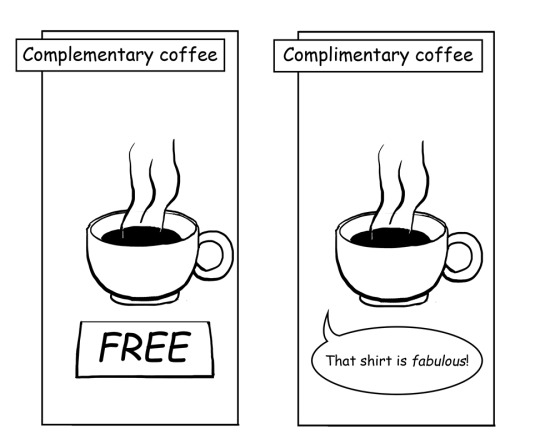
IT’S ‘MIGHT AS WELL’. ‘MIND AS WELL’ DOES NOT MAKE GRAMMATICAL SENSE.
A SNEAK PEAK WOULD BE A MOUNTAIN ENGAGED IN ESPIONAGE
THEY ARE VERY LARGE AND WOULD FIND THIS GENERALLY DIFFICULT
THANK
(OH AND ONE OTHER THING
BULLION = PRECIOUS METAL
BOUILLON = STOCK, FROM THE FRENCH “BOUILLER,” TO BOIL)
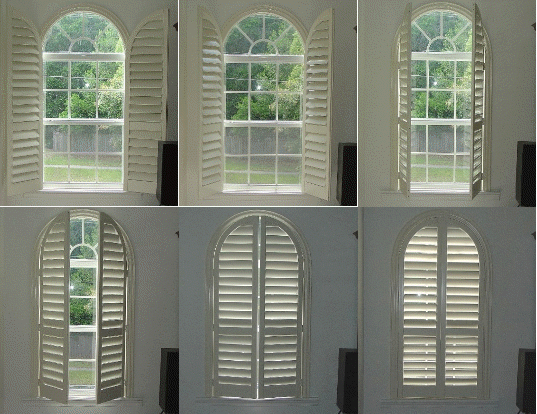
SHUDDER:
SHUTTER:
NOT SAME NOT SAME
sleight of hand: magic tricks
slight of hand: President-Elect
I love this post so much oh my god 😂
“A MOUNTAIN ENGAGED IN ESPIONAGE” I’m losing my shit
To my followers who speak & write in English as a second language: the caps locks and the frustration might come across as scary or even personally pointed, but all the information is valuable, even (and lbr ESPECIALLY) to native English speakers & writers!
Break= To shatter, stop working, be made to fall apart; the verb and noun form of “broken”
Brake= To attempt to stop; the part of a vehicle that allows one to stop
I do editing and proofreading semi-professionally, so believe me when I say that this is something a lot of native English speakers could learn something from. *pointed look*
The caps lock is a bit off putting, but as a native speaker (who actually isn’t too bad at the language and was testing far above her grade level all through school) that these are common mistakes and it’s okay if you make them- work on not doing it, but don’t beat yourself up if you make these mistakes. Especially if English isn’t your first language.
Listen. I’m an English Major who’s planning to go into editing professionally, and just this month I learned that Commiserate and Commensurate are not spelled the same way. If I can fuck this up, and learn from it, so can you. No judgement, just opportunities!
A small list of random ass sites I’ve found useful when writing:
Fragrantica: perfume enthusiast site that has a long list of scents. v helpful when you’re writing your guilty pleasure abo fics
Just One Cookbook: recipe site that centers on Japanese cuisine. Lots of different recipes to browse, plenty of inspiration so you’re not just “ramen and sushi”
McCormick Science Institute: yes this is a real thing. the site shows off research on spices and gives the history on them. be historically accurate or just indulge in mindless fascination. boost your restaurant au with it
Cocktail Flow: a site with a variety of cocktails that’s pretty easy to navigate and offers photos of the drinks. You can sort by themes, strengths, type and base. My only real annoyance with this site is that the drinks are sometimes sorted into ~masculine~ and ~feminine~ but ehhhh. It’s great otherwise.
Tie-A-Tie: a site centered around ties, obviously. I stumbled upon it while researching tie fabrics but there’s a lot more to look at. It offers insight into dress code for events, tells you how to tie your ties, and has a section on the often forgotten about tie accessories
Even more:
Types of High Heels: A page describing twenty five different types of high heels. It gives a description and pictures. Shake it up from just “stilettos and kitten heels”
Random Job Generator: Exactly as it says. The site offer more generators like characters, plots, or town names.
ok but like when did self-sacrifice become synonymous with death? writers seem to have forgotten that people can make personal sacrifices for the greater good without giving their lives. plots about self-sacrifice and selflessness don’t always have to end in death. suffering doesn’t have to be mourning. you can create drama and emotional depth on your show without killing everyone. learn to explore the meaning of living rather than dying
Death. Is. NOT. The. Only. Way. To. Advance. The. Narrative.
Fun things to sacrifice for your loved ones in your free time that don’t include death and actually set up for a whole new season of high level drama:
– humanity (mostly applicable to sci-fi/supernatural genre) – memories (mostly applicable to sci-fi/supernatural genre) – love for that special someone (mostly applicable to sci-fi/supernatural genre) – emotions (mostly applicable to sci-fi/supernatural genre) – rank/position/ – yourself/your brain/your skills (give yourself over to bad guys and become their brainwashed agent so your loved ones live) – years of bloody ruthless traditions to make way for peace (hi lexa and fuck jroth tbh) – freedom (includes that of speech/mind/will) – your grandpa’s fortune – hell even material possessions have that girl sacrifice her goddamn house so they can pay off her gf’s student loans or whatever juST STOP KILLING CHARACTERS TO FURTHER YOUR PLOT
Other things to sacrifice:
– your most sought-after goal
– a strongly-held belief or conviction
– your own chance at happiness
other fun things to sacrifice:
-a finger -an eye -10-20 years of your life -some of your vitality or dexterity -your ability to magically see in the dark -your proficiency in battle axes -your good looks -your memory of the man who killed your wife -everything but your head
Your entire emotional spectrum and ability to vent:
See- sense and sensibility, where the main character was surrounded by people loudly proclaiming their emotions and in order to keep all her loved ones as safe and well-fed as she could in her limited capacity, bottled her very broken, very injured heart to herself until she literally could not anymore.
See- persuasion, where the main character suffers sling shot after slingshot at her heart, dignity, hopes and pride, but still keeps a cool and calm head that manages to salvage what is left of the family name, house and reputation, while holding fast to a love that she very much thinks hates her.
So, because people writing inaccurate kid!fic bothers me, a quick reference to kids (Disclaimer: I have no professional background in child development, and no offspring of my own – this is all based on other people’s kids.):
Newborn: Person-larva. Cannot do much but eat, sleep, cuddle, cry, poop. Cannot hold their own head up. May pick up on the mood of the person holding them, but response to it is going to consists of either contentment or complaining. Those are pretty much the two states of a newborn: happily cuddly or expressing displeasure.
2 – 6 months: Somewhat more aware of surroundings, own appendages, etc. Will recognize people, like some better than others. Smiles, laughs, babbles. Somewhere in here rolling over commences, and possibly crawling. Starts teething.
6 -12 months: Lots of babbling, but no actual talking. Crawls, pulls self up to standing while holding onto things, may start wobbly independent walking. Some kids are climbers (may heaven help their parents). Eating some solid food (as in, mashed up stuff), but still nursing / drinking formula too. This is the beginning of the exploratory, everything-goes-in-the-mouth stage. Still teething.
1 year old: Has teeth, eats solid food. Many parents wean at this age, but it’s not unusual to continue breastfeeding. Talks, but probably not very clearly – pronunciation will be interesting, and vocabulary very limited. May repeat a new word incessantly. Points at things they want. Physical coordination and verbal skills increase as child gets older. Maybe develop utterly random phobias, usually of things that are new or unpredictable. Interested in other children, may mimic older children. Still sticks everything in their mouth.
2 years old: Speaks well enough to be understood by those who know them, but not necessarily strangers. Uses simple phrases. May mash words together to express a concept for which they don’t yet know the word, or make a word up. Is learning labels for things, though they may not be accurate (i.e. all old men are grandpa, all round objects are a ball, etc.) Knows colors, parts of the body, types of animals, etc. Walks, runs, dances, etc – basically the full range of physical stuff, just all of it is kinda awkward. Can roll a ball or throw it in a clumsy way. May have a favorite toy, security blanket, etc. May play pretend games or make up stories, but they’re likely to be fair inscrutable to adults. Wants to do things independently, but is likely to be easily frustrated. Has tantrums. Plays with other children, but not terribly good at sharing or being nice. Asks questions; the ‘why?’ stage has begun. Toilet training begins around this age; girls tend to get the hang of it quicker than boys.
3 years old – pretty much the same as 2, only a bit better at all of it. Asks a LOT of questions. Has friends. Plays pretend. Understands rules (though is unlikely to obey them very well). Can count, though not very far. Speaks well enough to be understood by strangers; you know that so-cute-you-could-die kid-speak people love to write? This is the appropriate age for it (up through about age 5).
4 to 5 – cutesy kid-speak is age appropriate. May still have tantrums, still not the best at sharing, but should be starting to get socially functional. Can throw or kick a ball, jump, stand on one foot, all that. Can count, recite alphabet. Some kids start learning to read and write arond this age, though it wouldn’t yet be abnormal for them not to be able to. Lots of pretend play. Emotionally intense; everything is dire. Learning to be self-maintaining, i.e. may bathe independently but needs an adult to wash their hair.
6 – 10 – speaks like an emotionally immature adult; the things they have to say are still kid-like, but they should be easing out of kid-speak. Reads, writes, can do math – these skills increase with age. Understands and (usually) obeys rules, has a concept of fairness, kindness vs. cruelty, etc. Forms tight friendships, keeps secrets, wants to fit in and be liked; having a best friend or a group of friends is the most important thing in their world. Wants to be good at things; has definite interests and academic strengths and weaknesses. May bully or be bullied; kids this age can be mean. As in horrifyingly so. Has crushes (though probably still finds it acutely embarrassing). Understands death. Kids this age will curse, though hilariously badly. Still wants parental affection, but probably not in public.
11 – 12 – mini-teen, which is to say emotionally vulnerable, short-sighted mini-adult. Naive still, but not terribly so – has a basic understanding of human nature, events around them, etc. Begins to form political / ideological / religious opinions. May begin reciprocal romantic attachments. Strongly focused on collective identity, what ‘niche’ or ‘crowd’ they identify with. Some girls start puberty. This is also the age of things going badly wrong; kids know which other kids are the sociopaths at this stage. While everybody else is learning how to not be a mean little shit to everybody unlike themselves (or a bitter perpetual victim), those few who aren’t developing in a good direction become downright terrifying.
13 – 15 – somewhere in here, kids will start either facing major adult-scale decisions and problems themselves, or seeing peers doing so. Shit gets real. This is why teenagers think they know everything; the rose-colored glasses of childhood fall off, and they are suddenly So Very Jaded and cannot imagine there being more to the world than what they can suddenly perceive now, because it is overwhelming. Likely to be angry at the world, likely to gravitate toward ideological extremes. Takes risks. Forms romantic attachments; may experiment sexually, may not, maturity levels here very A LOT.
16 – 21 – moody adult with far more curiosity than common sense. Does thing in grand and dramatic fashion. Experiments with different identities. Wants total independence. Many develop greater social maturity around this time; stop seeing others in terms of cliques, develop greater empathy and ability to see things from multiple perspectives. Forms romantic attachments that may be serious or even life-long.
This is pretty accurate IME, and if you want more detail for the first few years, try Touchpoints.
Can I just… talk for a moment… about how much I love how, if you know them well, words don’t have synonyms?
English, for example, is a fantastic disaster. It has so many words for things that are basically the same, and I find there’s few joys in writing like finding the right word for a sentence. Hunting down that peculiar word with particular meaning that fits in seamlessly in a structure, so the story flows on by without any bumps or leaks.
Like how a shout is typically about volume, while a yell carries an angry edge and a holler carries a mocking one. A scream has shrillness, a roar has ferocity, and a screech has outrage.
This is not to say that a yell cannot be happy or a holler cannot be complimentary, or that they cannot share these traits, but they are different words with different connotations. I love choosing the right one for a sentence, not only for its meanings but for how it sounds when read aloud. (Do I want sounds that slide together, peaceful and seamless, or something that jolts the reader with its contrast? Snap!)
I love how many words for human habitats there are. I love how cottage sounds quaint and cabin sounds rustic. I love steadiness of house, the elegance of residence, the stateliness of manor, and tired stubbornness of shack. I love how a dwelling is different to a den.
And I love how none of them can really touch the possessive warmness of all the connotations of home.
Words are great.
Words are art.
Whether art is carving, casting, painting, singing, dancing, playing music, stitching a tapestry or cooking a meal, well-chosen words can describe all of them with ease, elegance and grace.
Doing it the other way round is more problematic… 🙂
This reminds me of another post, “if I invite you to my cottage in the forest it sounds charming but if I invite you to my cabin in the woods it sounds like you’re gonna die.” [source, though it turns out I paraphrased]
I was thinking about this post about the good girl/bad boy trope, and the type of dudes I prefer to bad boys:
Big dude who looks like he could fold you like a pretzel, who people avoid because…well, pretzels, but is actually a gentle giant
Big, gruff, taciturn dude who doesn’t want to let people in (but can’t seem to help collecting strays and friends anyway)
Reformed Bad boy who has already grown up and out of his ~bad boy phase, but has to deal with constant suspicion and distrust due to his reputation
Dudes who have done morally questionable shit to protect or help people and are okay with being alone as long as the people he loves are happy
Dudes who have somehow acquired a bad boy rep and don’t understand how, but okay, he’s finally stopped fighting it
Dudes who aren’t entirely sure how to express their emotions and who show their affection in potentially weird and untraditional ways, but they’re learning, okay?
A handy list of poisons for writing reference, provided to you by me, Bella
Poisoning is one of the oldest murder tactics in the books. It was the old equalizer, and while it’s often associated with women, historically men are no less likely to poison you. This is not a guide on how to poison people, you banana bunches, it’s a guide on writing about poisons in fiction so you don’t end up on a watch list while researching them. I’ve taken that hit for you. You’re welcome. These are just a few of the more classic ones.
Hemlock: Hemlock (conium maculatum) is one of the more famous ones, used in ancient times most notably in Socrates’ forced suicide execution. So it goes. The plant has bunches of small, white flowers, and can grow up to ten feet tall. It’s a rather panicky way to die, although it wouldn’t show: hemlock is a paralytic, so the cause of death is most often asphyxiation due to respiratory paralysis, although the mind remains unaffected and aware.
Belladonna: Atropa belladonna is also called deadly nightshade. It has pretty, trumpet-shaped purple flowers and dark, shiny berries that actually look really delicious which is ironic since it’s the most toxic part of the plant. The entire plant is poisonous, mind you, but the berries are the most. One of the most potent poisons in its hemisphere,it was used as a beauty treatment, so the story says, and rubbed into the eyes to make the eyes dilate and the cheeks flush. Hench the name beautiful lady. The death is more lethargic than hemlock, although its symptoms are worse: dilated pupils, sensitivity to light, blurred vision, tachycardia, loss of balance, staggering, headache, rash, flushing, severely dry mouth and throat, slurred speech, urinary retention, constipation, confusion, hallucinations, delirium, and convulsions. It’s toxic to animals, but cattle and rabbits can eat it just fine, for some reason.
Arsenic: Arsenic comes from a metalloid and not a plant, unlike the others here, but it’s easily the most famous and is still used today. Instead of being distilled from a plant, chunks of arsenic are dug up or mined. It was once used as a treatment for STDs, and also for pest control and blacksmithing, which was how many poisoners got access to it. It was popular in the middle ages because it looked like a cholera death, due to acute symptoms including stomach cramps, diarrhea, confusion, convulsions, vomiting, and death. Slow poisoning looked more like a heart attack. The Italians famously claimed that a little arsenic improved the taste of wine.
Strychnine: Strychnine (strick-nine) is made from the seed of strychnos nux vomica and causes poisoning which results in muscular convulsions and eventually death through asphyxia. Convulsions appear after inhalation or injection—very quickly, within minutes—and take somewhat longer to manifest after ingestion, around approximately 15 minutes. With a very high dose, brain death can occur in 15 to 30 minutes. If a lower dose is ingested, other symptoms begin to develop, including seizures, cramping, stiffness, hypervigilance, and agitation. Seizures caused by strychnine poisoning can start as early as 15 minutes after exposure and last 12 – 24 hours. They are often triggered by sights, sounds, or touch and can cause other adverse symptoms, including overheating, kidney failure, metabolic and respiratory acidosis. During seizures, abnormal dilation, protrusion of the eyes, and involuntary eye movements may occur. It is also slightly hallucinogenic and is sometimes used to cut narcotics. It also notably has no antidote. In low doses, some use it as a performance enhancer.
Curare:Chondrodendron tomentosum is lesser known than its famous cousins, but kills in a very similar way to hemlock. It is slow and terrible, as the victim is aware and the heart may beat for many minutes after the rest of the body is paralyzed. If artificial respiration is given until the poison subsides, the victim will survive.
Wolfsbane: Aconitum has several names; Monkshood, aconite, Queen of Poisons, women’s bane, devil’s helmet) and is a pretty, purple plant with gourd-shaped flowers. The root is the most potent for distillation. Marked symptoms may appear almost immediately, usually not later than one hour, and with large doses death is near instantaneous. Death usually occurs within two to six hours in fatal poisoning. The initial signs are gastrointestinal including nausea, vomiting, and diarrhea. This is followed by a sensation of burning, tingling, and numbness in the mouth and face, and of burning in the abdomen. In severe poisonings pronounced motor weakness occurs and sensations of tingling and numbness spread to the limbs. The plant should be handled with gloves, as the poison can seep into the skin.
Foxglove: Digitalis is large with trumpet-shaped flowers that can be many colors, but usually a pinkish shade. It may have from the term foxes-glew, which translated to fairy music. Intoxication causes nausea, vomiting and diarrhea, as well as sometimes resulting in xanthopsia (jaundiced or yellow vision) and the appearance of blurred outlines (halos), drooling, abnormal heart rate, cardiac arrhythmias, weakness, collapse, dilated pupils, tremors, seizures, and even death. Slowed heartbeat also occurs. Because a frequent side effect of digitalis is reduction of appetite and the mortality rate is low, some individuals have used the drug as a weight-loss aid. It looks a bit like comfrey, which is an aid for inflammation. Make sure not to confuse the two.
As someone who writes fics with action sequences and the use of guns, I thought maybe it would be helpful to pass some things on. Even though I’ve done lots of research and talked with family members (I live in WI which is a big hunting state and we have lots of guns), I still catch myself making mistakes with specific terms and their usage. Reading more James Bond fics lately, I catch others making mistakes also. So here is a little guide to help writers.
A ‘clip’ is something that stores multiple rounds of ammunition. It is not what you would insert into a handgun to load it. Clips make loading into a magazine easier because they simply store the rounds. It helps with organization.
A magazine is what feeds the ammunition into the barrel. Magazines vary in capacity. They, unlike clips, are spring-loaded, which helps the ammunition move in the gun. So, when you want a character to reload, they would use a pre-loaded magazine, NOT a clip.
A silencer is really a suppressor. ‘Silencer’ is a word that’s used in media to refer to a suppressor that doesn’t exist in real life. Guns that are suppressed will still be loud and have a sound. This is because compressed air will still leak out of the end of the barrel, you can’t silence a bullet moving extremely fast through the air, and you can’t silence the mechanical parts on a gun. There will be a noise, but it just won’t be as loud or more importantly, alert people in a nearby area that a gun was just fired. SO suppressor is a much more accurate term technically speaking.
There are different kinds of suppressors. One important kind suppresses the muzzle flash. It’s likely a sniper would use this more than they would want to use a sound suppressor, as the muzzle flash more easily enables you to be spotted when you don’t want to be. These are simply referred to as flash suppressors.
After a handgun runs out of ammunition, the slide will lock back into place and you will know that it is out. There is no ‘click’ signifying an empty weapon that is so dramatized in movies and tv. A more likely scenario that would prevent a gun from firing would be a jam. Or programming the gun to recognize certain palm prints.
A great place for writers, in particular fanfic writers, who want information on guns is imfdb. You can find out what guns are used in movies and shows, and what guns characters use. You can also just search for guns.
If you want to get really specific, check out YouTube. There are users who will post reviews of guns on there, which can be really helpful if you want to see how a particular gun looks or how to shoot it.
So yeah! Here are just a few basic tips if you want to write a fic where a character uses guns.
I see you’ve got terminology down, now let’s go for a little technicality.
Firstly, let me explain the “kick” of a gun. A “kick” is the feeling of the round leaving the barrel of the gun. Every gun has one, the impact of the “kick” depends on the caliber, make and type of gun.
Another way to describe a kick is the feeling of the gun exploding in your hand. Of course, the gun doesn’t literally explode, but it is a great burst of power that only lasts a second.
For example: A .45 mm hand gun with have a bigger “kick” than a .22 mm hand gun. If someone is a first time shooter and does not know what to expect, they would most likely drop the gun after firing it once due to the shock of the force being released in their hands.
Sniper Rifles are incredibly accurate and mainly used for long distance hits. They are also ridiculously heavy, as most rifles are, therefore, be prepared for a gigantic “kick”.
Sniper Rifles are special because they are so powerful (they need to be in order to have the same impact a .45mm would 10 feet away compared to the shell half a mile away), thus a stand is required to use it.
No matter what you will always need a firm holding to place the rifle (besides your grip) in order to prevent the gun from falling over after it is discharged and injury to your person. There are ridiculously powerful guns.
General rule of thumb is that you place the butt of the rifle next to your shoulder, just below your clavicle. I’m not very good at describing this position, so I suggest looking it up. DO NOT place it anywhere in the armpit area, dislocation is likely to occur. Depending on how prepare you are and the type of rifle being used (excluding snipers), bruising might occur.
You will be standing if you use a normal rifle, so make sure you are steady and prepared for the “kick” that follows after.
If you are using a sniper rifle, you will be on the ground or leaning against something. Some people have special rests for their snipers specifically to fire the gun from any spot. Point is: do not stand alone while firing this. You will get hurt.
Other helpful tips:
Earplugs or Ear Protectors are your friends.
Safety glasses are also your friend to avoid shells from flying into your face.
Keep the safety on until you are ready to fire the gun.
If you are NOT currently firing the gun, whether it is loaded or unloaded, and it is in your hand, ALWAYS hold it with two hands and point it at the ground at your feet. DO NOT get distracted.
NEVER joke around with someone by pointing the gun at them. EVEN IF YOU ARE ABSOLUTELY POSITIVE THAT THE GUN IS TOTALLY UNLOADED, MAGAZINE OUT OF PLACE, DO NOT RISK IT. It is not funny. Even if the gun is on safety, do NOT do it. You could accidently switch off the safety or the gun could misfire despite the safety.
Lastly TWO HANDS. One on the side near the trigger and the other underneath. This is not the movies, do not attempt to fire a gun with one hand. Not only will your aim be incredibly off if you are inexperienced but you will also endanger yourself as well as others if you lose control of it.
Guns can be scary and if you ever feel nervous or uncomfortable about firing one, do not do it.
A few things I have to add to this:
The caliber of a round is usually measured in either millimeters or in hundredths of an inch. One “unit” of caliber, I guess, is one one-hundredth of an inch. For example, a 45-caliber round has a .45 inch diameter (which is why it’s called a .45). DO NOT CONFUSE THIS WITH MILLIMETERS. .45 mm is NOT 45-caliber.
Common cartridges measured in millimeters with their respective calibers:
Rifles:
5.56mm = ~.223 caliber
7.62mm = ~.300 caliber
12.7mm = ~.500 caliber
Handguns:
5.64mm = .22 caliber*
9mm* = .354 caliber
10.16mm = .40 caliber*
11.43mm = .45 caliber*
(*the measurement you’re more likely to see for each cartridge.)
In the case of rifles, cartridges meant for civilian use are usually designated as .223, .300, .308, etc. Designations such as 5.56mm, 7.62mm, etc. are usually indicative of military-grade ammunition. This is not always true, but usually that’s how it is.
Military-grade bullets are held to higher standards and typically cause more stress on the internal mechanism, and the guns they’re meant for are built to handle that. They can also handle civilian ammunition. It doesn’t work the other way around, however. Do not attempt to use military-grade ammunition in a civilian-model firearm that hasn’t been modified to handle it.
A few different kinds of cartridges:
– Full metal jacket, which gives increased penetration capabilities but doesn’t do much in the ways of expansion. Risky to use in situations with a lot of innocents around, as often they can over-penetrate and go on to hurt someone behind the target.
– Hollow-points, which expand like crazy when they hit something, causing massive internal damage to their target. Outlawed in warfare under the Hague Convention of 1899, but can be used by civilians.
– Soft-points, which serve as a happy medium between the penetration capabilities of full metal jacket rounds and the expansion of hollow-point rounds.
– Shot, usually rat-shot or snake-shot, which can be fit in bullets and used to kill small vermin at close range without doing a whole lot of damage to the surrounding area.
– Sub-sonic, which have a lower muzzle velocity and effective range, but will decrease the chance of overpenetration. This is also the ideal ammo choice for weapons fitted with suppressors, as subsonic rounds avoid the “crack” of a sonic boom that other bullets can make upon leaving the barrel.
 saratogaroad