Okay but after seeing this I started doing it too and it’s amazing how many men I’ve run into bc they expected me to move
Gotta try it
I work (and walk) on a college campus. I’ve lost count of how many men I’ve smacked shoulders with.
Recently, I was standing outside my son’s classroom waiting to talk to his teacher. I stood on one side of the hallway, not even close to the center. At some point, a man came walking along. I was standing right in his path, but the hallway was empty, so I logically expected him to swerve around me. Instead he kept walking right toward me, got to me, and stopped, as if waiting for me to get out of his way. I didn’t; I just smiled politely at him. He finally walked around me, clearly annoyed that I hadn’t leapt out of his manly path.
Now I’m wishing I’d leapt aside, taken off my jacket and laid it on the floor before him, then bowed deeply and said, “My Liege!”
I also work at a college campus. I smack shoulders sometimes, but I find that if I stare straight ahead and follow the advice below, people get the heck out of the way.
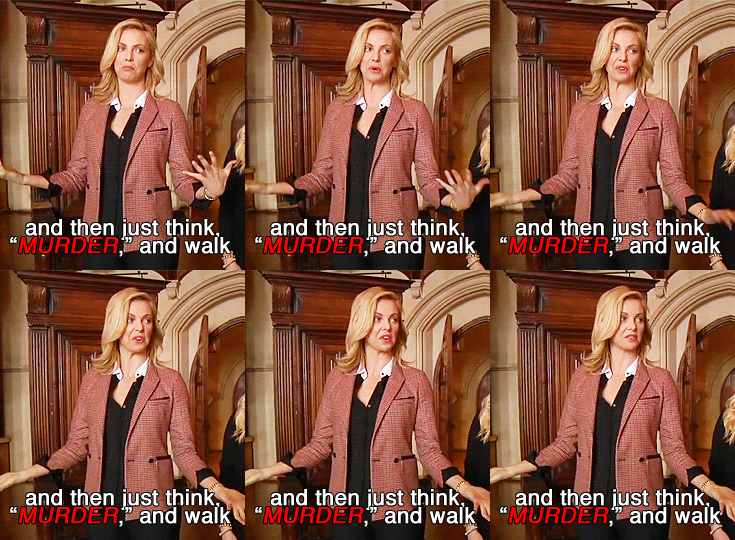
Honestly this post changed how I carry myself when walking alone in public, or in a situation where I’m the one leading. People definitely move for the murder gaze.
Confirmed. I once had to rush back inside a convention hall as the con was closing in order to a retrieve a sick friend’s medication, and I didn’t understand why people in the crowd were jumping out of my way (literally—one guy vaulted a table) until I realized I was dressed as the Winter Soldier and doing the Murder Walk because that’s just how I walk in those boots. I got the meds, got out, and made a mental note.
I repeated the experiment later, wearing the boots but otherwise my usual clothing and mimicking the expression I thought I’d had at that moment. People parted like I was Charlton Heston.
I now wear that style of boots whenever possible. I recently had a man do a double-take as I walked by and ask me, politely, where I had served because I “looked like a soldier.” I’m not current or former military. I was wearing a flowy purple peasant top and looked as un-soldierlike as possible.
Moral of the story: wear comfortable shoes, square your shoulders, and walk like you’ve been sent to murder Captain America.
MY NEW ATTITUDE: Moral of the story: wear comfortable shoes, square your shoulders, and walk like you’ve been sent to murder Captain America.
when you go from a bad situation into a better one you may collapse exhausted and unsure what to do and full of grief, you may need time to regain the ability to do things as yourself or motivated by anything other than terror, you may need time to process or mourn or fall apart in ways you could not before,
and people may use this as proof that the old situation was better for you, proof that you need to go back, and it is not proof that it was better for you or proof that you need to go back
!!!
It’s so incredibly common to “fall apart” when you’re finally safe. You no longer need to stay so tightly coiled in on yourself, you can finally leave survival mode and process your trauma. You’re not holding yourself up by sheer terror anymore and suddenly the damage that terror has done to you becomes immediate and obvious.
This is so important. Don’t go back. Things are already getting better, even if it doesn’t feel that way.
This is a documented phenomenon with abuse in particular. I’ve had a number of people ask me why they’re falling apart now after they’ve moved into a safer home, or they’re in a less dangerous area, or they’ve left an exploitative job, or they’re in a healthy relationship for the first time. Generally, it’s because they made that positive change.
When we’re still in the midst of crisis, we’re often too overloaded and physically/emotionally unsafe to really feel or process anything. So for most of us, everything gets pushed down/repressed/dissociated until later, when we’re safe and supported. The threshold of safety at which processing begins to occur varies from person to person. And the mental calculations used to determine “safety” usually happen on an unconscious level. Very few of us have the conscious thought “I’m safe now, so I can process what happened to me.” Instead, the subconscious realizes some level of safety has been achieved, and so it just dumps a load of suppressed stuff.
Sometimes, it’s contrast to past experiences that makes us realize something was traumatic at all. In such cases, it’s not that we’ve reached a level of safety and can thus begin to process, it’s that we finally have a basis for comparison to know that what went before was unacceptable.
this is also the case for getting treatment/medication for an ongoing illness. it’s theorized that’s why antidepressants sometimes seem to cause suicide – someone who was too defeated and exhausted to even try to kill themself might react to the return of energy by following through on suicidal ideation they just didn’t have the wherewithal to address before.
i’ve even observed something similar with physical illness. when i found a pain medication that worked for my chronic pain, i slept like 14 hours a day for the first couple weeks – because finally i COULD sleep without being woken up by pain.
please spread the word that it’s normal to faceplant when a long-term stressor is removed. you’re not getting worse. you’re starting to heal.

 saratogaroad